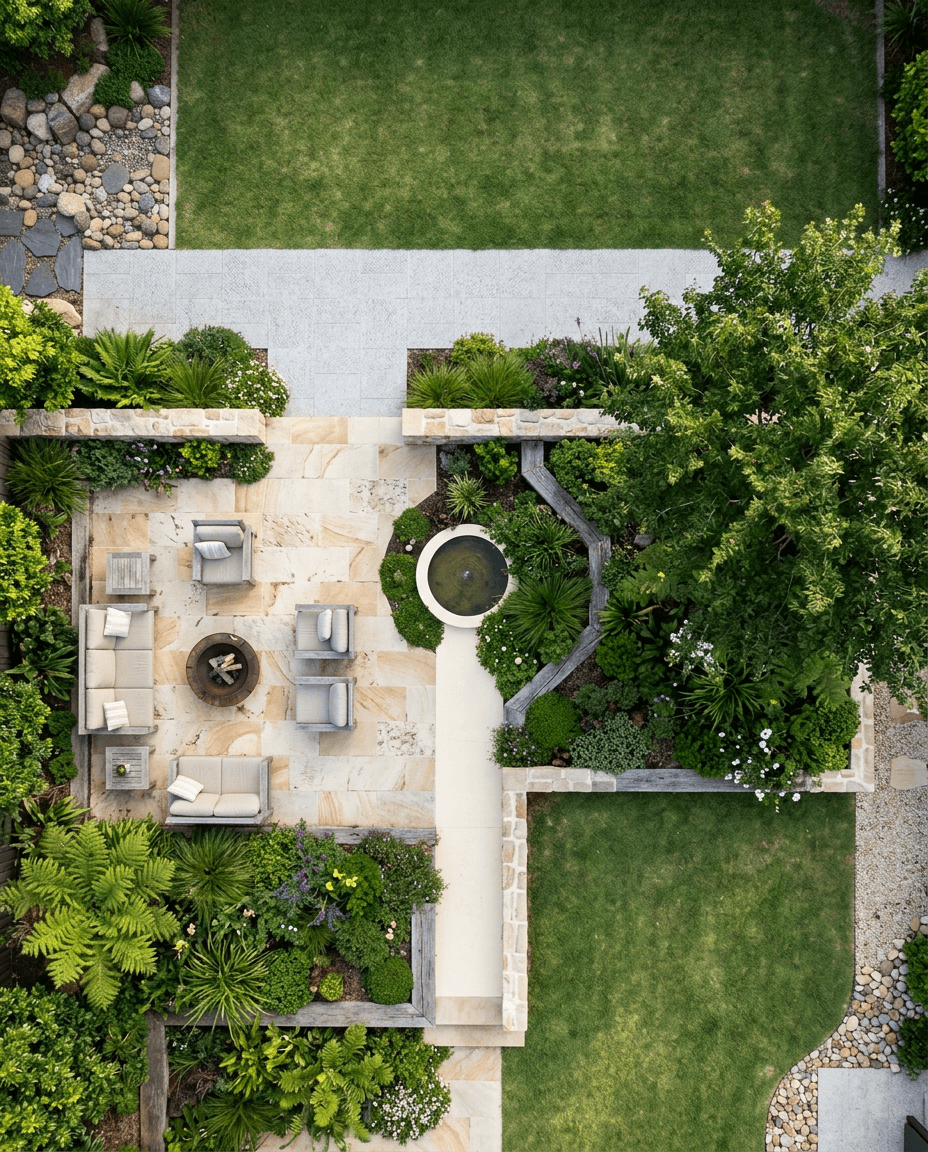
Rock & stone landscaping · Photo Listicle ·
31+ Rock Landscaping Ideas That Will Make Your Neighbors Stop
Affiliate disclosure · Earthwork earns commission on some links
Rocks don't bloom and rocks don't die. That's the entire pitch for rock landscaping: structure that holds the yard together in January when everything else has gone brown. The right rock-and-stone moves carry the design through three seasons of dormancy without ever asking for water, mulch, or replanting.
These 31 rock landscaping ideas are organized around the four main material types: boulder, river rock, gravel mulch, and stacked stone. Each has different price points, install difficulties, and aesthetic outcomes. Mix two or three for visual variety; commit to one for design discipline.
Boulder accent (the West-Coast / mountain answer)
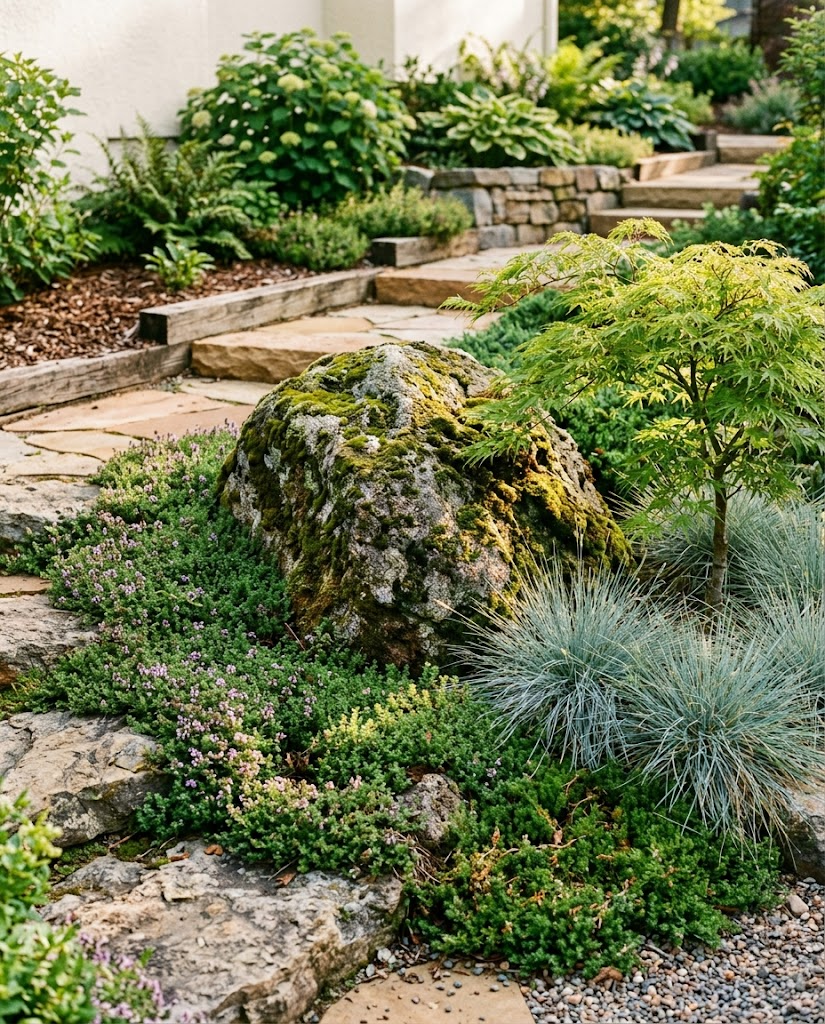
A single 30 to 48-inch boulder of native fieldstone, half-buried so it reads as exposed bedrock rather than dropped-in landscape. Plant low ground cover (creeping thyme, dichondra, blue fescue) around the base to soften the transition. Boulders cost $150 to $600 each plus delivery. The half-buried rule matters: a boulder sitting on the lawn looks like Stonehenge, half-buried it looks geological.
Dry creek bed (the drainage solution that looks intentional)
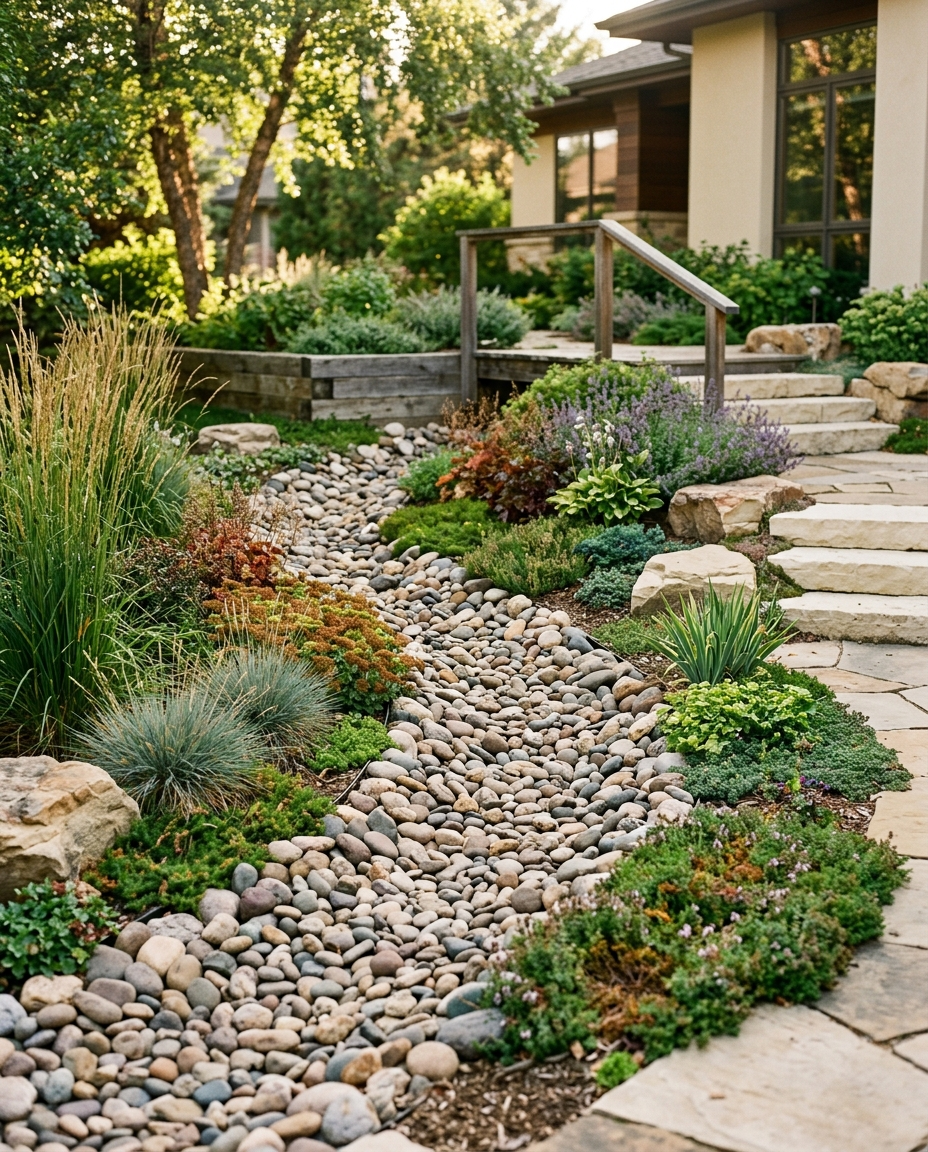
A meandering 18 to 36-inch-wide channel of mixed river rock (1- to 4-inch rounded stones), excavated 6 inches deep, lined with landscape fabric, then filled with the rock. Reads as a dry stream bed; functions as actual drainage in heavy rain. Works on any slope, native to any aesthetic. About $4 to $7 per linear foot in materials for a 24-inch-wide bed.
Gravel mulch over weed barrier
3/4-inch crushed granite or 3/8-inch pea gravel laid 3 inches deep over a permeable weed barrier (Mirafi, not the cheap nursery fabric). Best around mature shrubs that have aged past the heavy-feeding stage. Cuts weeding to zero, looks crisp, lasts 8 to 12 years before needing refresh. About $2 to $4 per sq ft installed.
Stacked stone retaining wall
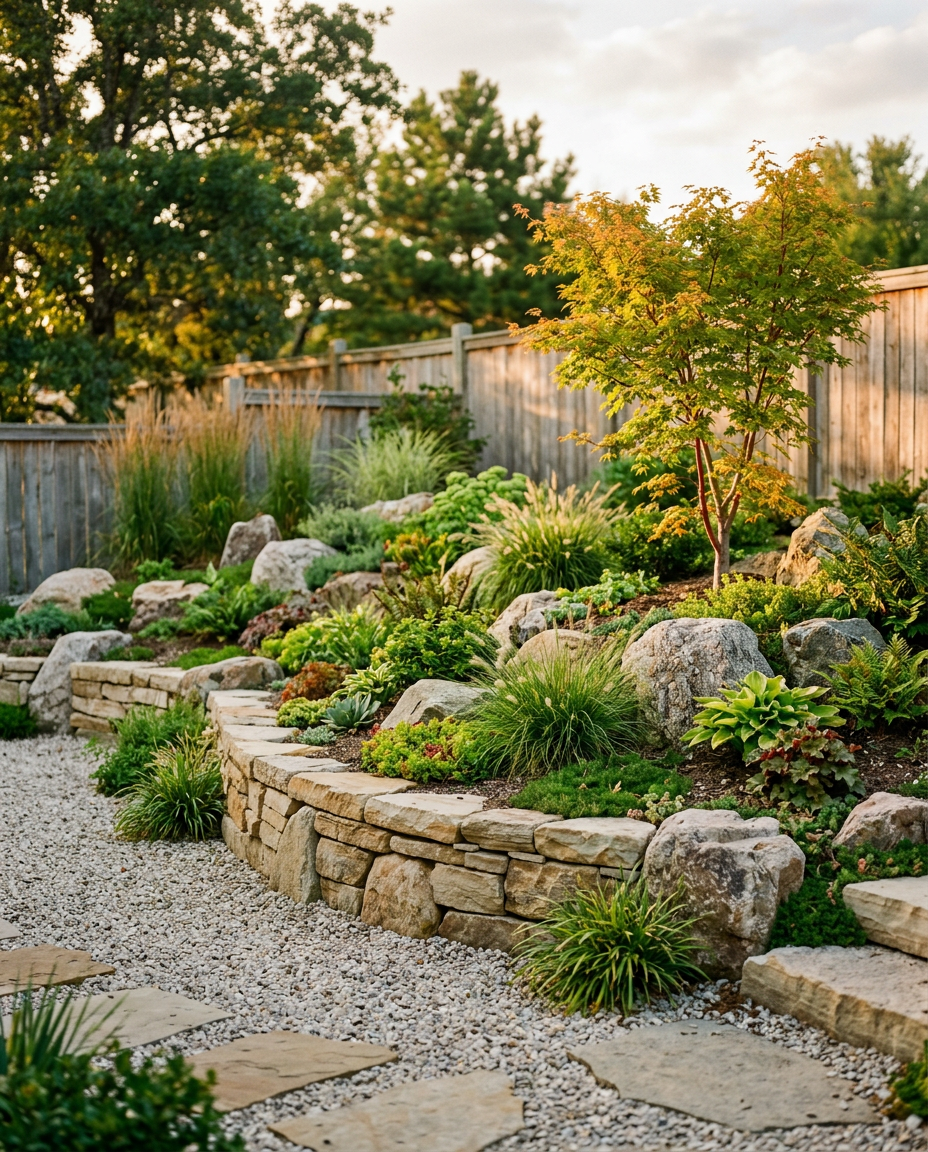
A 24 to 36-inch dry-stacked retaining wall built from local fieldstone or Pennsylvania bluestone. No mortar; gravity does the work as long as each stone has a "good face" outward and the wall tilts 2 to 3 degrees back into the slope. Costs $25 to $60 per linear foot for a homeowner build. Walls over 4 feet require engineering and a permit in most jurisdictions.
Stepping stones on grass
24-inch flagstone slabs (or poured 16-inch concrete circles) set into the lawn at 22-inch on-center spacing. Cut sod 2 inches deep, drop the stones in flush with the grass so the mower clears them. Mowing happens unchanged; the path appears underfoot. About $8 to $20 per stone depending on type. The garden path & walkway hub has more variants.
River-rock surround for a fire pit
A 12-foot circle of 2- to 4-inch round river rock around a center fire pit, 3 inches deep, edged with steel restraint. Replaces lawn that would otherwise scorch from the fire heat. Reads as designed; functions as defensible space. About $200 in stones for a 12-foot diameter circle.
Boulder cluster (the rule of 1)
For boulder placement: 1 large, 1 medium, 1 small in a triangular relationship (NOT in a straight line). Total: 3 stones, with the largest 1.5 to 2x the size of the medium, the medium 1.5 to 2x the smallest. The asymmetric grouping reads as natural rock outcrop; symmetric grouping reads as cemetery. Total cost: $300 to $1,200 depending on stone source.
Crevice garden (the alpine version)
Flat fieldstone slabs set vertically on edge, 60 to 80 degrees off horizontal, with the gaps between filled with sharp gravel and planted with rock-garden perennials (sedum, sempervivum, dianthus, dwarf phlox). Reads as a slice of alpine scree slope. Best in full sun on a south-facing slope. Materials: $150 to $400 for stones, $80 for the planting.
The Japanese rock garden (karesansui)
5 to 7 carefully placed stones representing islands, surrounded by raked white or grey gravel representing water. Plant a single black pine, a small Japanese maple, or a moss garden at the perimeter. Best on a 12-by-12 to 18-by-18 footprint. Cost: $300 to $1,200 for stones + raked gravel; the design effort is more than the budget.
Rock-edged planted beds
Tennessee fieldstone or Vermont fieldstone laid as a 6-inch-high border around planted beds. Stones set on a compacted gravel base; backfilled with soil on the bed side. Reads as historic country, ages into the landscape, no mortar needed. About $8 to $14 per linear foot in materials.
Pea gravel courtyard
A 10-by-12 patio of 3/8-inch pea gravel three inches deep, edged with steel restraint, with stepping stones cutting through for the main pass-through. French country in feel, fast install (a single weekend), affordable. $4 to $7 per sq ft. Crunchy underfoot, easy to refresh.
Mexican beach pebble accent
3- to 5-inch smooth black-grey Mexican beach pebbles in a discrete 4-by-8 strip somewhere in the bed (under a water feature, around the base of a statue, lining a planter). Pricey at $15 to $25 per bag; use sparingly as accent, not bulk fill.
Rock garden with succulents
A south-facing slope or raised mound, mounded with gritty soil mix (50% sharp gravel, 50% topsoil), planted with hardy succulents (sempervivum, sedum, hens-and-chicks) and accent stones. Zero irrigation once established. Best in zones 5 through 9 (succulents that overwinter in cold zones).
How to source landscape rocks
Local landscape supply yards (search "landscape supply near me") are 50 to 80% cheaper than big-box stores for bulk stone. Bring a pickup or arrange delivery (typically $80 to $200 for a 5-ton load). For boulders, pick them in person — the stone yard photo on the website never matches what arrives. For gravel, request a sample bag first; granite, basalt, and limestone gravels read very differently in color and shape.
How much rock landscaping costs
For 200 sq ft of rock garden with mixed boulders, gravel mulch, and a few stepping stones: - DIY with materials only: $400 to $900 - Pro install with planting: $2,500 to $5,500 - Premium install with named boulders and crevice planting: $7,000 to $15,000
The unit-cost driver is the stone weight. A standard pallet of fieldstone weighs 3,500 to 4,000 pounds. Moving that across the yard burns 4 to 8 hours of labor without machinery, or one hour with a skid-steer.
FAQ
Frequently asked questions
What's the cheapest rock landscaping idea that still looks designed?
A 3-inch layer of 3/4-inch crushed gravel as mulch around existing mature shrubs, with a steel edging restraint at the bed edge. Replaces wood mulch (which decomposes annually) with stone (which never decomposes). About $2 per sq ft installed.
Do rock landscaping ideas like these work in shade?
Most do better in full sun than in shade. Boulder accents work anywhere. Dry creek beds, gravel mulch, and stacked stone walls work anywhere. Crevice gardens, succulent rock gardens, and Japanese rock gardens want sun. For shade, swap planted species: hellebores, hostas, and ferns hold up in shaded gravel-mulched beds.
How long does rock landscaping last?
Essentially forever for the rocks themselves. The structural elements (retaining walls, edging) last 30+ years with no maintenance. The gravel layer fades and compacts; refresh with a thin top-dressing every 4 to 8 years. The planting around the rocks needs the same care as any planting.
Will rocks attract or repel pests?
Gravel mulch under existing shrubs reduces hiding cover for slugs, snails, and rodents compared to wood mulch. Stacked stone walls provide nesting sites for chipmunks and small snakes (which keep rodent populations down). Boulders attract wasps and other insects to the underside; lift one occasionally to check if you've created a problem.
Can I install rock landscaping ideas like these myself?
Yes for gravel mulch, pea gravel patios, stepping stones, and small dry creek beds (under 20 feet). Yes for boulders under 18 inches diameter if you have a strong back. No for retaining walls over 3 feet, boulders over 24 inches, or any install that requires a Bobcat to move material.
These 31 rock landscaping ideas all answer the same question: what does the yard look like in February? The yard that holds up year-round is the one with stone bones that don't go dormant. Pick a few boulder placements, edge a bed with stacked stone, top-dress one zone with gravel — and the yard suddenly has structure that's there in summer, fall, winter, and spring without any effort from you in any of them.