Decks · Design Lookbook ·
41 Backyard Deck Ideas That Look Like Pinterest Brought Them to Life
Affiliate disclosure · Earthwork earns commission on some links
The deck is the piece of the yard that costs more than people expect, lasts less long than people expect, and gets more daily use than almost any other outdoor surface they own. Get it right and it's the family room for six months of the year. Get it wrong and you're replacing boards every two summers and watching the bill add up.
These 41 backyard deck ideas are organized around the material choice that drives everything else. Cedar, ipe, composite, and PVC each lead to different railings, different fastener systems, different stain schedules, different lifespans. Pick the material first and the design follows; pick the design first and the material picks itself, sometimes badly.
Ipe (the gold standard)
A South American hardwood with a density that resists rot, insects, and split for 25 to 40 years. The new install reads as warm chocolate; left untreated, it silvers in two seasons. Cost: $14 to $24 per square foot for the boards plus $8 to $14 installation. Total: $22 to $38 per sq ft installed. The premium hardwood that's actually worth the premium.
Western red cedar (the classic American)
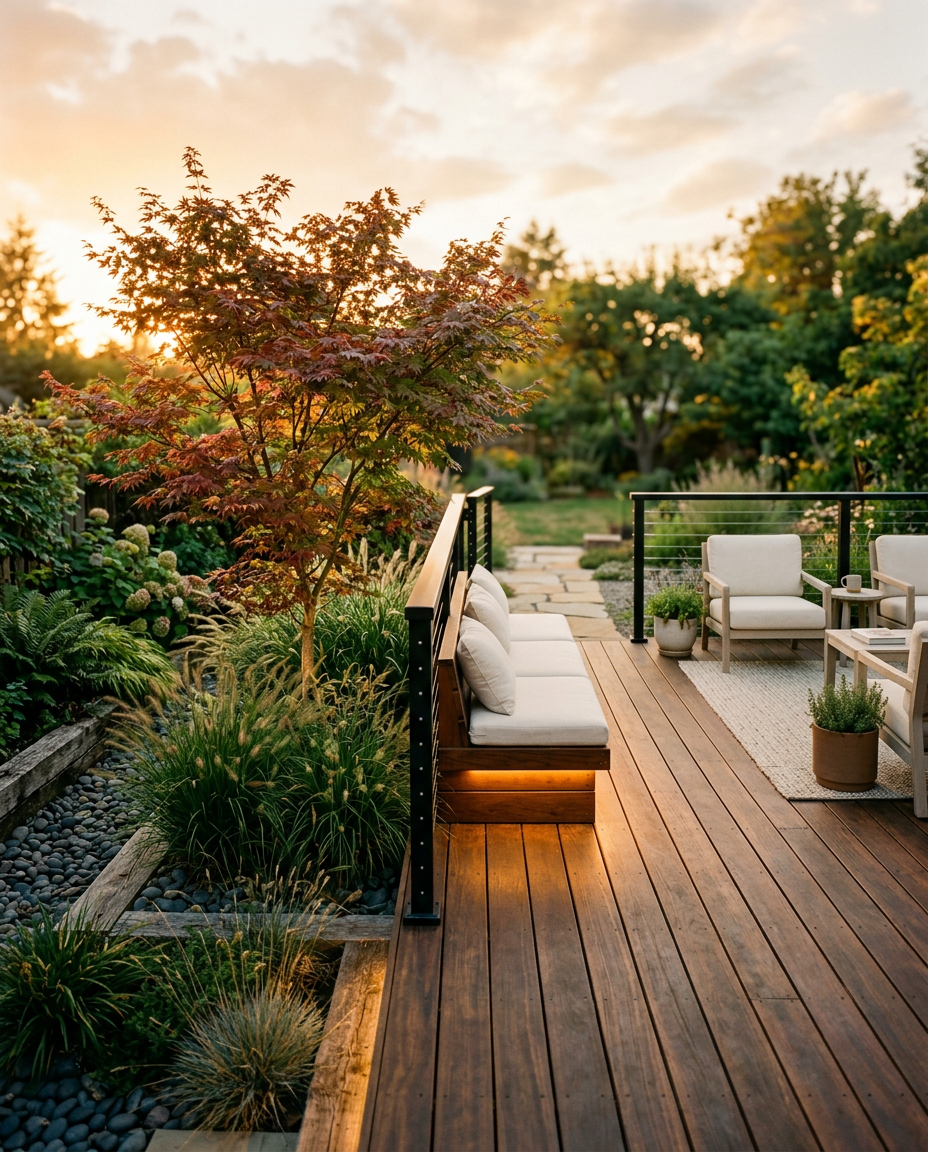
Domestic, sustainable, lighter than ipe and easier to work with. Pre-stain with Penofin to preserve the warm tone; without stain, cedar silvers to a soft grey in 18 to 24 months. Lifespan with annual staining: 20 to 30 years; without: 10 to 15. About $6 to $10 per square foot for boards plus $6 to $10 installation.
Composite (Trex, TimberTech, Fiberon)
Wood-plastic composite boards in dead-flat color that doesn't fade or stain. 25 to 30 year warranty. Heavier than wood, which means more substantial framing. About $9 to $15 per sq ft for boards plus $8 to $12 installation. No staining ever, but boards can scratch (heavier composites scratch less) and color choices are limited to what the brand sells.
PVC capped (Azek, TimberTech AZEK)
100% PVC core capped with a UV-resistant outer layer. Lighter than composite, lasts 40+ years, color stays accurate across decades. About $12 to $20 per sq ft for boards plus $8 to $14 install. The right answer for coastal, high-humidity, or freeze-thaw climates where wood doesn't last and composite gets sweaty.
Pressure-treated pine (the budget tier)
The lumber-yard standard. $2 to $4 per sq ft for boards plus $6 to $10 install. Lasts 8 to 15 years depending on climate and stain routine. Reads as utility, not residential, unless you stain it warm and add cedar railings. The right answer for outbuilding decks, kid's playhouse decks, or short-term residences.
The multi-level deck for sloped yards
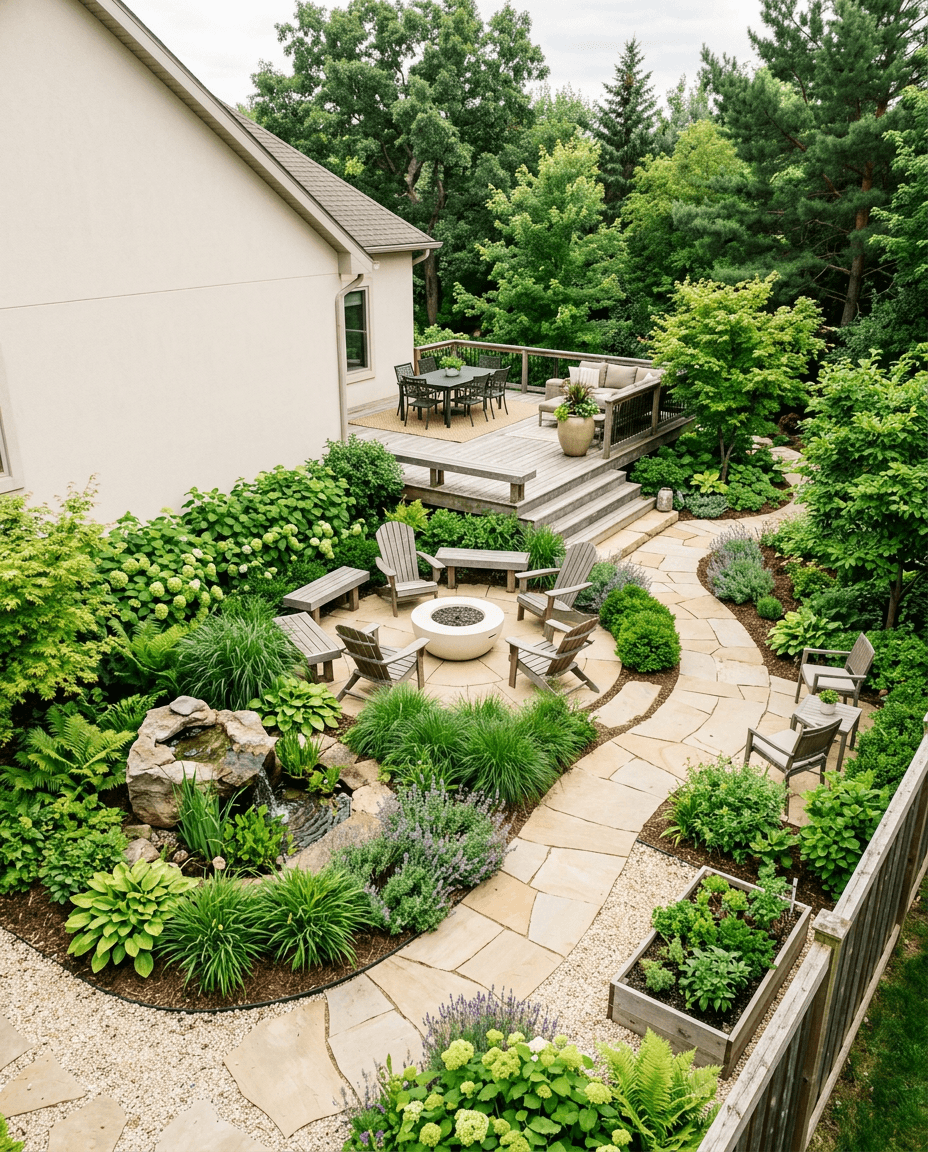
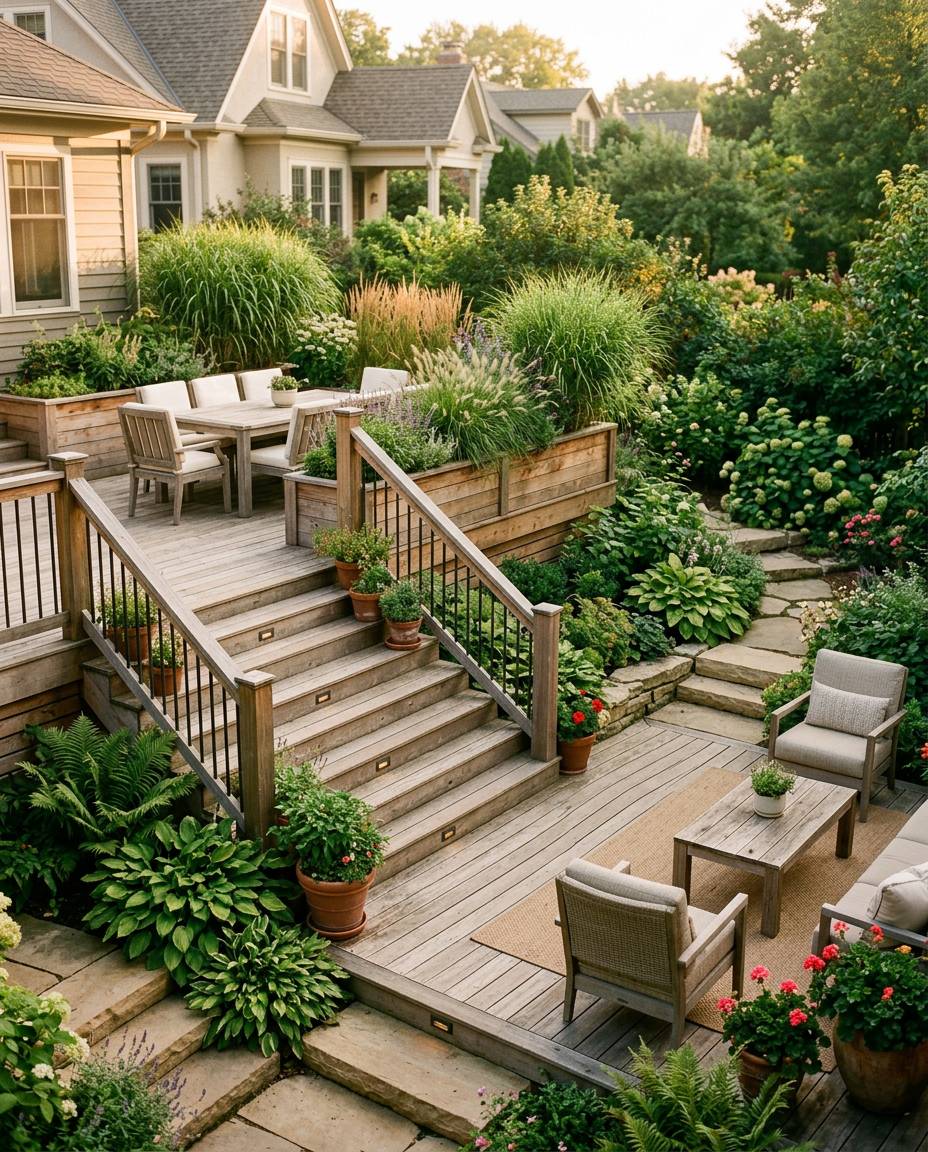
If your yard has any grade, build the deck as a stepped series of platforms (24-inch drops between levels) instead of one tall single platform on long posts. The visual result reads as part of the landscape; the structural result is simpler framing and shorter posts. Plus each level becomes a defined zone — upper for dining, lower for lounging.
The wraparound deck
The deck that goes from the back door around to the side of the house. Adds another 100 to 200 sq ft of usable outdoor space and creates the path from front porch to back deck without going around the entire house. Best for split-levels, ranches with side entries, and any house where the back door is in a corner instead of the center.
Built-in bench seating around the perimeter
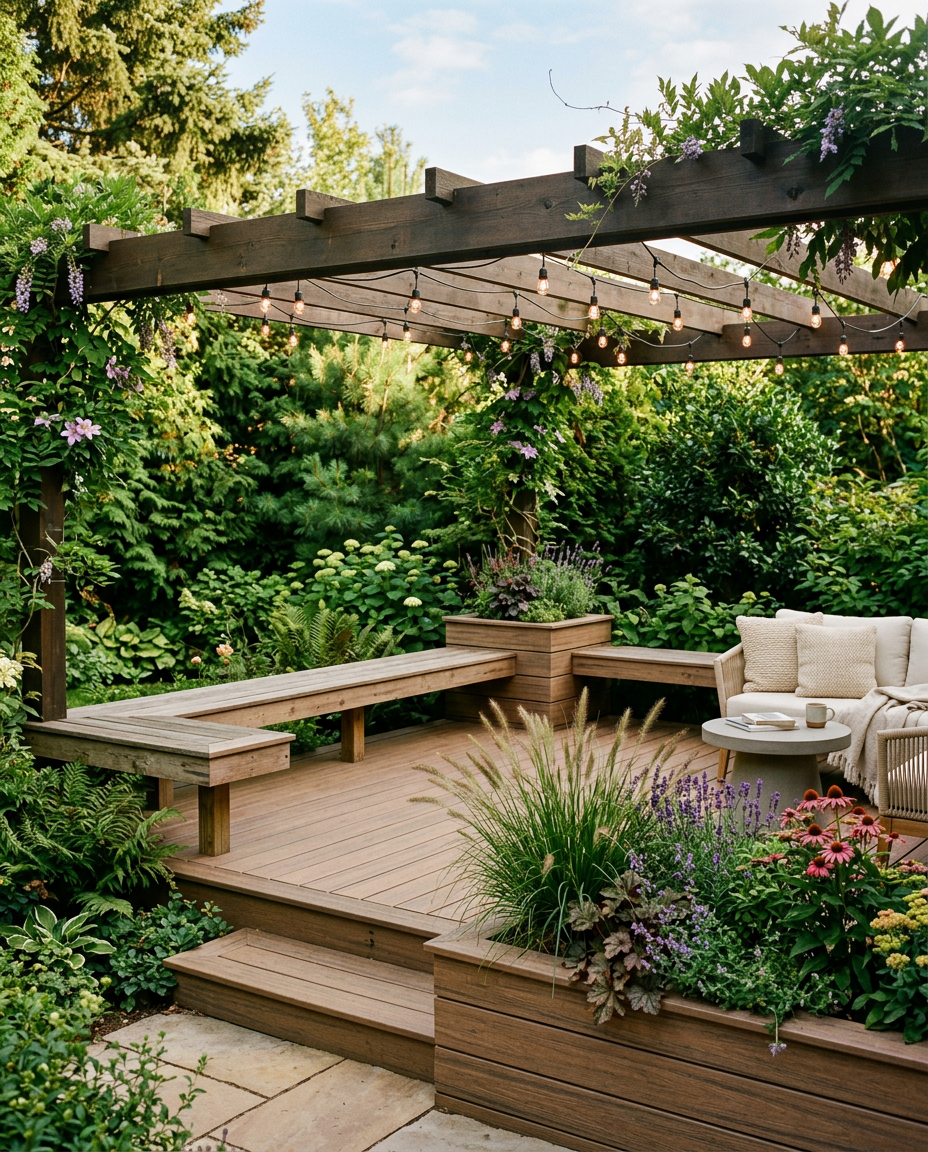
A 12-inch-deep cedar bench that runs around two sides of the deck, doubling as railing where the deck is more than 30 inches above grade. Adds about $40 to $60 per linear foot. The bench changes the deck's function from "platform you put furniture on" to "outdoor room with built-in seating." Storage cabinets underneath hold cushions, gardening tools, and the cooler.
Integrated planter boxes
12-inch cedar planters built into the deck's edge or corners, filled with seasonal annuals, dwarf shrubs, or perennial grasses. Adds visual softening without taking deck surface area. Pro-tip: line the planters with EPDM membrane and add drainage so they don't rot out the deck framing underneath.
The deck-and-pergola combination
A 10-by-12 cedar pergola centered over the dining zone of the deck, with 2x10 beams and 2x6 rafters at 24 inches on center. Provides dappled mid-day shade and a structural anchor for string lights. Adds $2,500 to $5,500 to a deck build. Worth it on south- or west-facing decks where the noon sun is the problem.
Hidden fasteners (worth it on every wood deck)
Skip face-screws that show. Use side-mount hidden fastener systems (Camo, Tiger Claw, Cortex) that secure the board from the underside or edge. The deck surface stays clean and the boards have no penetrations to admit water. Adds about $0.50 to $1.00 per sq ft in fastener cost.
Tile-style modular decking (for rooftops and small spaces)
12-by-12 ipe, teak, or composite tiles that snap together over an existing concrete patio, balcony, or rooftop. No framing required, no permits typically required (depends on jurisdiction). $8 to $20 per sq ft. The right answer for renters, condo owners, or any deck-over-existing-slab scenario.
Floating deck with no railing
A grade-level deck (deck surface less than 24 inches above grade) requires no railing by most code. Run the boards out to the edge with a 2-inch picture-frame border in a contrasting wood, and the deck reads as a contained patio instead of a "deck." Best when the surrounding grade is flat enough that no fall hazard exists.
Wrap the railing in cable for views
For decks with a view (lake, woodland, distant hills), replace traditional balusters with horizontal 1/8-inch stainless steel cable strung between top and bottom rail. The view shows through; the safety code is met. About $35 to $55 per linear foot for the cable system vs. $18 to $25 for wood balusters.
How to budget a backyard deck build
For a standard 14-by-20 deck (280 sq ft) at single-level grade: - Pressure-treated pine: $3,500 to $6,500 - Western red cedar: $5,800 to $9,500 - Composite (Trex Enhance / mid-tier): $9,000 to $14,000 - PVC (AZEK / TimberTech): $11,000 to $17,000 - Ipe: $14,000 to $22,000
Add 25 to 50% for raised decks (over 30 inches above grade), multi-level builds, integrated benches, or pergolas. Subtract 15 to 25% for full DIY (you provide labor, contractor's profit margin disappears).
FAQ
Frequently asked questions
What's the longest-lasting backyard deck material?
PVC capped at 40+ years, followed by ipe at 25 to 40 years if oiled annually for the first three seasons. Composite at 25 to 30 years. Cedar at 20 to 30 with annual staining; 10 to 15 without. Pressure-treated pine at 8 to 15.
Do backyard deck ideas like these increase home value?
Yes — a well-built deck typically returns 60 to 75% of its cost at resale, which is one of the highest ROI outdoor projects. Composite decks return slightly better than wood because buyers see "no maintenance" as a feature. Ipe decks return less in absolute terms because the cost-per-sq-ft is higher than the perceived value.
How long does it take to build a backyard deck?
A 14-by-20 standard deck: 4 to 7 days with a 2-person crew. Add 2 to 4 days for built-ins (benches, planter boxes, stairs), 3 to 5 days for a pergola. Permits and inspections add 2 to 6 weeks before construction starts.
What's the most important detail on a backyard deck?
The flashing where the deck meets the house. Improperly installed (or skipped) flashing causes the rim joist to rot, which rots the ledger board, which collapses the deck. Every deck-meets-house joint needs metal flashing kicked out at least 4 inches above the deck surface, capped with siding.
Do I need a permit for a backyard deck?
Almost always yes for any deck over 30 inches above grade, any deck attached to the house, or any deck over 200 sq ft. Floating grade-level decks under 200 sq ft sometimes skip the permit but check your municipality.
These 41 backyard deck ideas all come back to the same first decision: pick the material that matches how long you'll be in the house and what maintenance you'll do. Ipe rewards a 15-year horizon. Composite rewards a no-maintenance preference. Cedar rewards an active stain routine. Pressure-treated rewards "I just need a surface for five summers." Match the deck to the timeframe and the rest of the design picks itself.