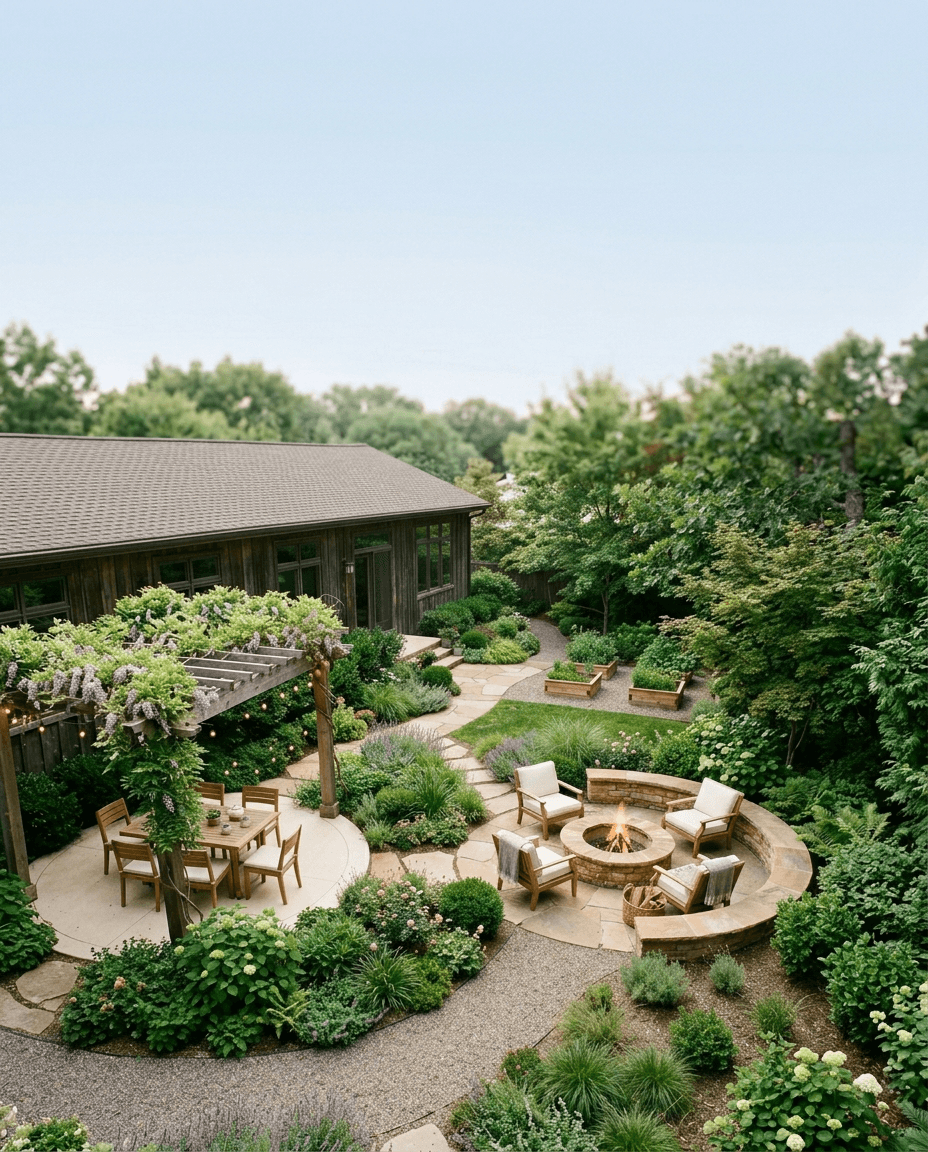
Fire pit designs · Photo Listicle ·
15+ Backyard Fire Pit Ideas That Will Make Your Neighbors Stop
Affiliate disclosure · Earthwork earns commission on some links
The fire pit is the only piece of yard furniture that earns its place in October. Long after the hammock's been folded and the patio table's gathering pollen, the fire pit pulls people into the yard for one more evening. These 15 backyard fire pit ideas all start from that thought: build a fire feature you'll actually sit around three seasons a year, not the four-foot Pinterest moment that gets photographed once and ignored.
Each one comes with a real cost range, a fuel-type recommendation, and the surround it works with. Pick the one that matches your patio, your fuel preference, and your tolerance for ash.
Sunken fire pit with stone bench seating
A 36-inch fire pit dropped 18 inches below grade, with a continuous stone bench at the bench-height ring around it. Pennsylvania bluestone, 2-inch thickness, set on a compacted-stone base. Fits 6 to 8 people on the bench. The sunken-pit feeling beats a raised one every time. Total cost as a homeowner build runs $1,500 to $2,500 in materials.
The copper bowl on a paver pad
A 36-inch hand-hammered copper fire bowl from Restoration Hardware or a smaller artisan source, sitting on a 10-by-10 paver pad. The copper ages to a dull green-brown patina across two seasons. Reads as restrained and intentional in a yard that doesn't want a built-in pit. Movable, season-storable, $400 to $1,200 depending on size.
Concrete-block construction (the budget classic)
Forty 8x8x16 concrete blocks, dry-stacked in three rings, no mortar, with a steel insert ring at the center. Total bill: about $200 in blocks plus $80 for the insert. Looks rough on day one, but a year of soot and a single wash gives it the patina that pricier pits buy outright.
The square Cor-Ten cube
A 36-inch square Cor-Ten steel fire pit on a flat slab. Industrial-modern, oxidizes to a deep rust, doubles as a sculptural element when not lit. Best in modern and contemporary yards. Brands like Solus Decor and Modfire run $800 to $2,200 for a quality cube; cheaper online versions skip the proper steel thickness.
Linear gas trough (the modern restraint)
A 48-inch stainless-steel gas trough on a stone or concrete base, fed from a buried propane tank or natural-gas line. No ash, no smoke, no fuel-fetching trips. The trade-off: a real fire smells better and looks better. Linear gas pits run $1,200 to $3,500 installed, plus the gas line.
Fire pit ringed by Adirondack chairs
Six Polywood or cedar Adirondacks arranged in a 12-foot circle around a 30-inch wood-burning fire pit. Adirondacks need 4 feet of clearance from the pit edge, which sets the circle diameter. The angle of an Adirondack puts the sitter at the right reclined angle for staring into a fire. Hardly any other chair gets this right.
Sunken pit with fieldstone retaining walls
For yards with grade, drop the fire pit into a stone-lined pit, with the surrounding walls doubling as backrests and seating. Local fieldstone, dry-stacked. Costs more in labor than materials but the result reads as part of the landscape, not added to it.
Fire pit on gravel (the casual answer)
A 30-inch steel ring set in a 12-by-12 pad of 3/8-inch pea gravel three inches deep, with a steel edging restraint around the perimeter. Casual, fast to install, easy to relocate. Best for cottage-style yards or any setup where formality is wrong. Total budget: $400 to $700.
The fire pit pavilion (for people who actually use it)
A 14-by-14 paver patio with a centered 36-inch fire pit, a pergola overhead at 9-foot height, and string lights from corner to corner. Builds an outdoor room around the fire instead of an outdoor object. The pergola changes everything: rain stops being an event-killer, and the lights extend the season into November. The full pergola menu lives in our backyard patio & pergola hub.
Three-season pit with a chimney pull-through
A traditional wood-burning fire pit (24 inches across) with a 6-foot chimney pipe (the kind used on chimineas) installed off-center. The chimney pulls smoke up and away, which means the seating circle stops getting smoke in the eyes when the wind shifts. Worth the $80 chimney attachment if you actually use the pit.
Reclaimed-brick fire pit (the cottage-historic answer)
A 36-inch round pit built from reclaimed clay brick, two courses high above grade, with a heavy steel insert ring at the bottom. Mortared, sealed, capped with a flat brick course. Cottage-style yards earn it; modern yards don't. About $300 to $600 in salvaged brick plus labor if you DIY.
The portable smokeless
Solo Stove Bonfire or Yukon. Stainless steel, double-wall combustion chamber that genuinely produces less smoke than a traditional wood pit. About $300 to $500 retail. Move it anywhere, fold-up. The smokeless claim is real, not marketing. You can sit downwind without your shirt smelling like a campfire for three days.
Low circular pit with a planted ring
A 24-inch fire pit at center, 12 feet of pea gravel out, then a low planted ring of ornamental grass (fountain grass, blue fescue) or lavender at the outer edge. The planting absorbs the visual edge of the gravel and gives the pit a "clearing in the meadow" feeling. Best for yards with the space for a 16-foot diameter.
How to choose your fuel type
Wood-burning is best for ambiance and smell, but you'll be storing seasoned firewood and managing ash. Best for casual use one or two nights a week.
Propane is clean, no ash, instant on-off via a switch. Best for entertaining and last-minute fires. A standard 20-pound tank lasts about 14 hours of medium-flame use.
Natural gas is the cleanest option, no tank refills, but requires a buried gas line installed by a licensed contractor. Best for full-time entertainers and second outdoor kitchens. Higher install cost (gas line trenching), zero ongoing fuel cost beyond the meter.
FAQ
Frequently asked questions
What's the cheapest backyard fire pit idea?
A 36-inch concrete-block ring with a steel insert costs about $280 in materials. Three rings of 8x8x16 blocks dry-stacked, the insert at the center. Looks intentional once it's been used a few times.
How far should a fire pit be from the house?
Code minimum is 10 feet from any structure (including overhead branches), but 15 feet is the comfort distance once you start using it. A pit at 10 feet feels close on a windy night; at 20 feet you're walking too far in October.
What surface can a backyard fire pit go on?
Stone, paver, concrete, gravel (with a steel restraint), or bare earth (with a ring of stone surround). Never on a wood deck. Never directly on grass that you intend to keep alive. The heat radiating downward kills turf within three uses.
Does a backyard fire pit need a permit?
Permanent built-in fire pits often do. Check your municipality. Portable fire pits (anything you can lift and move) generally don't, regardless of fuel type. HOAs sometimes ban them; rentals sometimes prohibit. Read the lease before you build.
What's the safest fuel for a backyard fire pit?
Natural gas is the lowest-risk for unattended use: no embers, no airborne sparks, instant shutoff via a valve. Wood-burning carries the most romance and the most risk. Never leave it unattended, always have a hose or extinguisher in reach.
The 15 backyard fire pit ideas above all answer the same question: what's the build that matches how you'll actually use it? The biggest mistake is buying a fire feature for a fantasy that doesn't match your lifestyle. Pick the pit you'll light 30 nights a year, not the one that wins the photograph.